
Most vessels don’t ‘have a water system’ in the way they have a fuel system or a power system. Not in how it’s specified. Not in how it’s maintained. And often not in how it’s organized internally. What many organizations have instead is a collection of separate pieces of equipment: a water maker from one supplier, pumps and pressure sets from another, heating from another, and something for treatment somewhere in between.
That distinction matters. Because onboard water quality is not determined by one component. It is the result of how all parts of the chain work together, from production or bunkering, through treatment and storage, to distribution and use. When those steps are treated as separate boxes, real control over water disappears.
Fragmentation hides the chain
A recurring issue in onboard water systems is that they are not viewed as one integrated chain. They are seen as loose equipment, sometimes even installed in different locations. Each with its own supplier, its own scope, and its own responsibility.
In practice, that leads to fragmented decisions. Equipment is purchased individually. Installation and maintenance are split. And when problems appear, such as brown water, corrosion, unexpected biological growth, the focus often moves downstream, tackling visible symptoms instead of addressing causes earlier in the system.
The reality is, good onboard water is not the outcome of a single device. It is the outcome of an entire chain that needs to be designed and managed as one system.
A useful comparison: onboard water as a small utility
A helpful way to understand this is to compare a vessel to a hotel on land. A hotel depends on a municipal water supplier for its source, but that does not remove its responsibility for the internal water system. It still needs the right pumps, appropriate materials, flushing program for low-use outlets, design choices that limit dead legs, backflow protection, regular analysis, and a clear water plan.
On board a vessel, the responsibility is even broader. The operator is often responsible not only for distribution and use, but also for the production of water itself. That makes chain-thinking essential. Treating onboard water as scattered equipment ignores the fact that it behaves like a small utility that requires continuous control across all stages.
What gets lost when water is treated as boxes
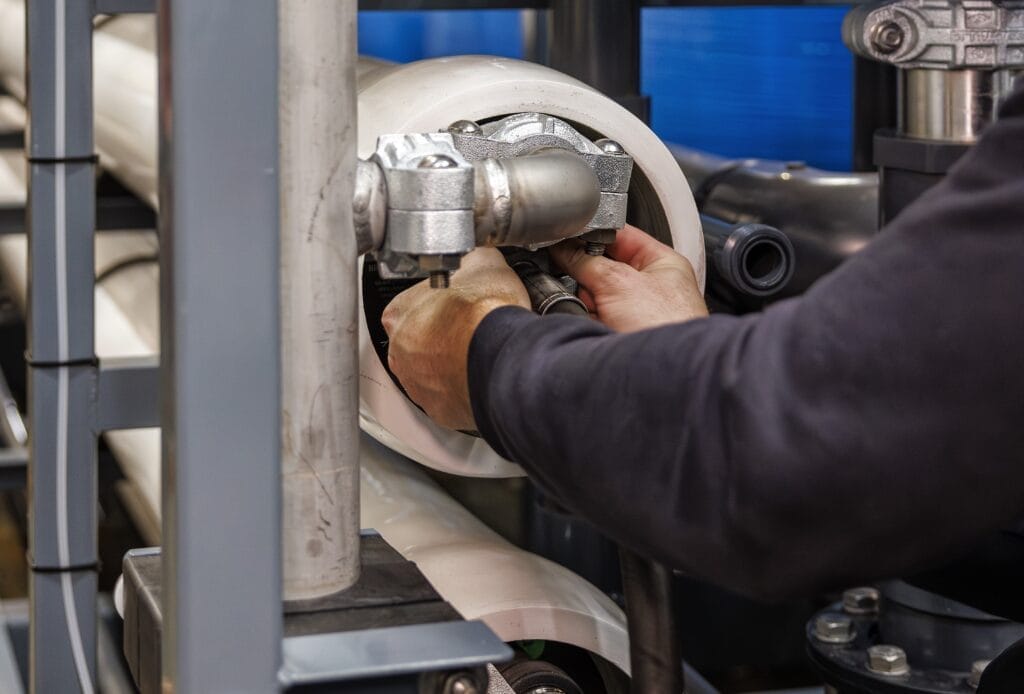
When water systems are specified as separate components, critical design and performance parameters tend to disappear from view. Questions that matter in professional water treatment, such as how much water is produced per square meter of membrane, how filtration flow rates are controlled, or how long water remains in contact with conditioning media, are often missing from ship specifications.
The same applies downstream. A component like a calorifier can be delivered exactly as ordered, but without system-level calculations there is no guarantee that the return temperature in the vessel will actually meet the intended operating conditions.
Each individual component may appear correct in isolation, but together they can create a system that slowly drifts away from stable, predictable performance.
Hidden system effects
System-level effects also appear in areas that are rarely associated with water quality. Piping, for example, is often oversized to guarantee capacity. But oversized piping reduces flow velocity, increases residence time and creates conditions where scaling and biological growth become more likely. These choices can even increase vessel weight. An operational consequence that is seldom part of a component-by-component discussion.
These are not exceptional failures. They are predictable outcomes of a fragmented approach, where water is treated as a collection of purchases rather than a chain with a defined performance objective.
Why a chain perspective matters
Water is often considered a non-primary system because it is not directly linked to revenue generation. As a result, it rarely receives the same degree of system engineering and operational discipline as other onboard systems because it is not framed as one coherent asset.
That framing creates a market of interconnected but poorly aligned systems, where each supplier optimizes their own scope while overall performance is left unmanaged.
One practical takeaway
The key lesson is simple: stop evaluating onboard water as individual pieces of equipment. Start evaluating it as one system.
That shift changes the conversation. It moves focus from individual components to chain performance, from local fixes to system stability, and from reacting to problems to preventing them.
Most importantly, it raises the organizational question that cannot be avoided once water is seen as a chain: who is responsible for the performance of that chain as a whole?
How can we help?
Whether you need information, advice, a quote or have any other question, we’re here to help.
Choose your region
Contact us

Request a quote