
Understanding the maritime potable water system
- Insights, Maritime, Offshore, Water Quality
Reading time: 8–10 minutes
On most vessels, potable water is treated as something that simply needs to work. If water is produced, tanks are filled and inspections are passed, it is easy to assume the system is under control. In practice, real control comes from understanding how the system behaves as a whole.
The image below shows a simplified potable water setup on board. It visualises something that is easy to overlook in day-to-day operations: every step depends on the previous one.
The water maker influences tank conditions. Tanks influence disinfection stability. Distribution determines what actually arrives at the tap. On paper, each part performs a clear function. In practice, performance depends on how they interact.
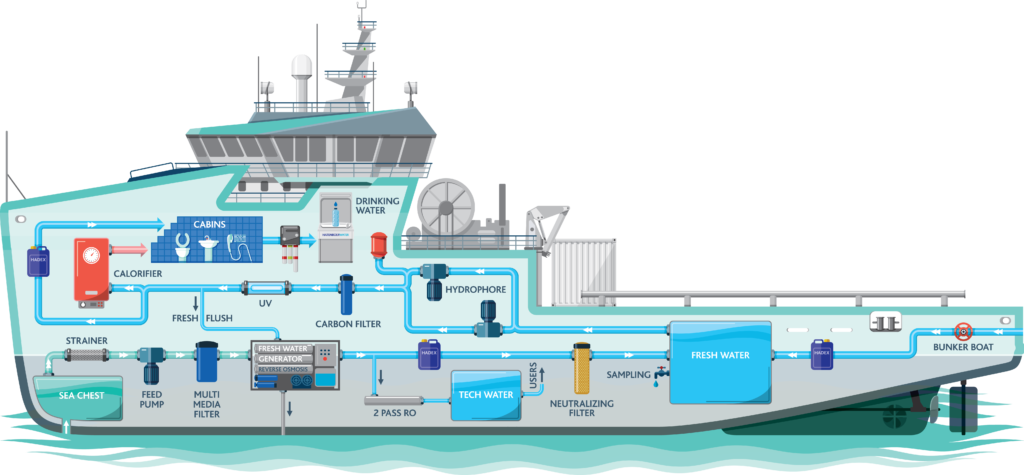
Water quality deviations are not always caused by a single equipment failure. More often, they result from gradual changes across the system that collectively reduce overall stability.
For technical teams, this is where the real challenge sits. Not in understanding individual components, but in how the system behaves under day-to-day operating conditions.
A typical maritime water setup in practice
Let’s take a closer look at each step.
Water intake and bunkering
Water enters the potable water system either through seawater intake or via bunkering from an external source.
Bunkered water can vary significantly in quality, and contamination can occur during transfer. Basic checks such as flushing hoses, verifying free chlorine levels and performing simple onboard measurements provide an important first indication of water quality.
💡Expert tip:
If water quality changes shortly after bunkering, always consider the intake as a potential source. Many system issues originate at this point, even when the onboard system is functioning correctly.
Pre-treatment and filtration
Before seawater reaches the water maker, it passes through pre-treatment and filtration steps designed to remove suspended particles.
This typically includes multimedia or sand filtration, followed by finer filtration through cartridge filters. The goal is straightforward: protect the system from solids that would otherwise cause fouling or damage sensitive components such as RO membranes.
💡Expert tip:
Filtration performance depends on operating conditions and can vary significantly, as vessels move between different environments and water conditions change.
Rather than relying on fixed replacement intervals, monitor the pressure drop across cartridge filters. As resistance increases, solids are accumulating and performance starts to decline. In many cases, a pressure drop of around 1 bar is used as a practical indicator that replacement is required. Sand filters typically backwash automatically, but as cartridge filters are disposable they require manual replacement based on actual operating conditions.
Fresh water production
Fresh water on board is typically produced through evaporation or reverse osmosis. Both systems convert seawater into fresh water, but they differ in how they operate and what they depend on in day-to-day conditions. Reverse osmosis systems, for example, rely on pressure and electrical power, making them less dependent on engine load and heat availability.
RO systems produce very clean water by removing salts, particles and microorganisms from the feed water. What remains is low-mineral water with little buffering capacity.
Detailed comparison between Reverse Osmosis and Evaporation?
Conditioning
Conditioning ensures water is stabilised before it comes into contact with tank surfaces and the wider distribution system. While this step is often associated with taste, its primary function is to protect the system. Stable water chemistry helps prevent corrosion, reduces material stress and supports more predictable performance in downstream processes such as disinfection and distribution.
Neutralisation and mineralisation stabilise the water by increasing its pH and reintroducing minerals such as calcium and hydrogen carbonate.
When conditioning is not functioning as intended, the effects are usually gradual. Changes in pH, increased dosing demand or inconsistent water quality are often early indicators that the system is drifting out of balance.
💡Expert tip:
Monitor pH trends rather than single measurements. A slow shift over time is often the first sign that conditioning capacity is decreasing or needs adjustment.
In systems using a neutralising filter, make sure there is sufficient calcium carbonate in the filter. As the material gradually dissolves, capacity reduces and system stability can decline without immediate visibility.
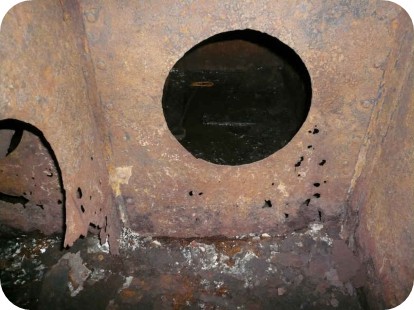
Potable water tank disinfection
Once water leaves the production stage, it becomes part of a wider network of tanks, pipework and equipment. To prevent microbiological growth in these areas, initial disinfection is typically applied as a preventive measure, often through controlled dosing using solutions such as Hadex.
Pressure control
Once water has been produced and stabilised, it needs to be distributed across the vessel in a controlled and consistent way.
A hydrophore system maintains pressure in the potable water network, ensuring that water reaches all tap points under varying demand conditions. While this is often seen as a purely mechanical function, it also directly influences how the system behaves.
Pressure stability determines how water moves through the network. Fluctuations can lead to irregular flow patterns, local stagnation or pressure drops, particularly at remote or low-use points in the system.
These effects are not always visible, but they have a direct impact on water quality. Disinfectant residuals may become inconsistent, and areas with limited flow can become more difficult to control over time.
In space-constrained engine rooms, larger legacy hydrophore systems are increasingly being replaced with more compact, frequency-controlled hydrophore solutions. While these configurations support space-efficient designs, they also change how the system responds to varying demand.
💡Expert tip:
If you experience inconsistent chlorine levels or recurring issues at specific locations, do not focus on dosing alone. Check pressure stability and flow behaviour, as these often explain why certain parts of the system behave differently.
Filtration
After the hydrophore, activated carbon filtration is commonly used to improve taste and remove organic compounds. At the same time, filtration changes system behaviour.
Activated carbon, for example, removes chlorine. Without taking that effect into account, a system can unintentionally lose part of its microbiological protection further downstream.
This is not a reason to avoid carbon filtration. It is a reminder that every treatment step needs to be aligned with the overall system.
Disinfection distribution system
UV disinfection often is applied as the primary barrier within the potable water system. It works by inactivating microorganisms as water passes through the unit, preventing regrowth. This makes UV an effective and chemical-free treatment.
Chlorine dosing and UV disinfection are both widely used, often in combination. UV treats water at a specific point in the system. Chlorine continues to protect water as it moves through tanks and pipework. Together, they form multiple barriers.
💡Expert tip:
UV lamps gradually lose their effectiveness over time, even when they still appear to function normally. Without proper replacement intervals, systems may no longer achieve the required level of disinfection. Regularly verify UV performance and replace lamps according to specifications, rather than relying on visual or operational checks alone.
Not all chlorine sources are suitable for continuous disinfection. Stable, controlled dosing is required to maintain consistent residual levels throughout the system. Using products such as pool chlorine tablets can lead to fluctuations in chlorine concentration. This creates peaks and gaps in protection, making the system harder to control.
Hot water generation
Calorifiers introduce specific conditions within the potable water scheme. Elevated temperatures influence both water chemistry and disinfection behaviour.
Prolonged exposure to chlorine can affect system components, particularly sensitive parts such as heating elements. For that reason, the calorifier and its feed line are typically not continuously chlorinated. Control of the hot water system instead relies on maintaining sufficient temperature and proper circulation. Hot water systems should be maintained at a minimum of 60 °C at the return line.
💡Expert tip:
Special care is required during shock disinfection. Calorifiers are typically isolated to prevent exposure to high chlorine concentrations. Not all yards are equally aware of this. Make sure the calorifier is explicitly excluded from shock treatment when specifying or commissioning the work.
Point-of-use filtration
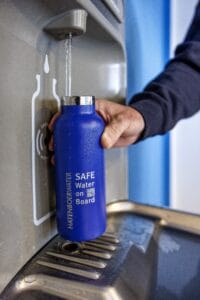
Increasingly, additional treatment is applied at the point of use. This includes filtration applied close to where water is consumed, such as bottle filling stations.
These systems improve the final stage of water quality by enhancing taste, removing any remaining particles or contaminants and increasing user confidence in the water on board.
At the same time, point-of-use treatment does not replace system-wide control. Water quality at the tap still depends on how the entire system is managed.
For that reason, final disinfection and residual protection, often maintained through controlled Hadex dosing, remain essential to ensure consistent water quality throughout the system, including at the point of use.
💡Expert tip:
Water quality is only part of the story. Crewmembers need to trust the water before they drink it. Consistent taste, clear appearance and stable quality at the tap all play a role in that perception. Point-of-use solutions such as filtration or bottle filling stations can help reinforce this trust.
If the crew avoids drinking from the tap, it is often a signal that something in the system does not feel right, even if measurements are within limits. Awareness and training can help crews better understand how the system works, what normal conditions look like, and when to raise concerns.
Understanding water quality
from daily testing to laboratory analysis
Maintaining control of a potable water system requires more than understanding how it is designed. It also depends on how it is monitored in practice.
Onboard testing provides immediate insight into key parameters such as chlorine residual, pH, temperature and conductivity. These measurements are essential for daily control and help identify changes in system behaviour at an early stage.
At the same time, onboard testing has its limits. It is primarily used for monitoring and screening, not for full verification.
Parameters such as microbiological quality, including Legionella or total bacterial counts, require laboratory analysis. These tests provide a more complete understanding of water quality and are typically performed periodically as part of compliance and risk management.
In practice, both approaches serve a different purpose. Onboard testing helps you stay in control on a day-to-day basis. Laboratory sampling confirms whether the system meets required standards and remains safe over time.
💡Expert tip:
Do not rely on a single type of measurement. Stable daily readings combined with periodic laboratory verification provide the most reliable indication of how your system is performing.
Final thought
A potable water system rarely fails suddenly. It moves, step by step, away from its intended state.
Production remains stable, but tank conditions change. Disinfection becomes less consistent. Distribution introduces variation. Over time, those small changes accumulate.
Looking at the system as a whole makes that movement visible. And once that becomes visible, it becomes something you can actively control.
About the author
This article is based on Hatenboer Water’s experience in designing, maintaining and supporting maritime potable water systems worldwide.
It reflects how these systems behave in day-to-day operations, and where practical challenges typically occur across production, storage and distribution.
Last reviewed: June 2026
Assess your set-up
Frequently Asked Questions
What is the most common cause of water quality issues on board?
In most cases, issues are not caused by a single failure, but by gradual changes across the system that affect overall stability.
Why is RO water not directly suitable for consumption?
RO systems produce low-mineral water, which can be slightly aggressive and requires conditioning before distribution.
Why is point-of-use filtration not enough on its own?
Because water quality at the tap depends on the entire system, not just the final treatment step.
What is buffering capacity?
Buffering capacity is the ability of water to resist changes in pH. It helps absorb fluctuations and keeps water chemistry stable, even when conditions in the system change.
How can we help?
Whether you need information, advice, a quote or have any other question, we’re here to help.
Choose your region
Contact us

Let us contact you